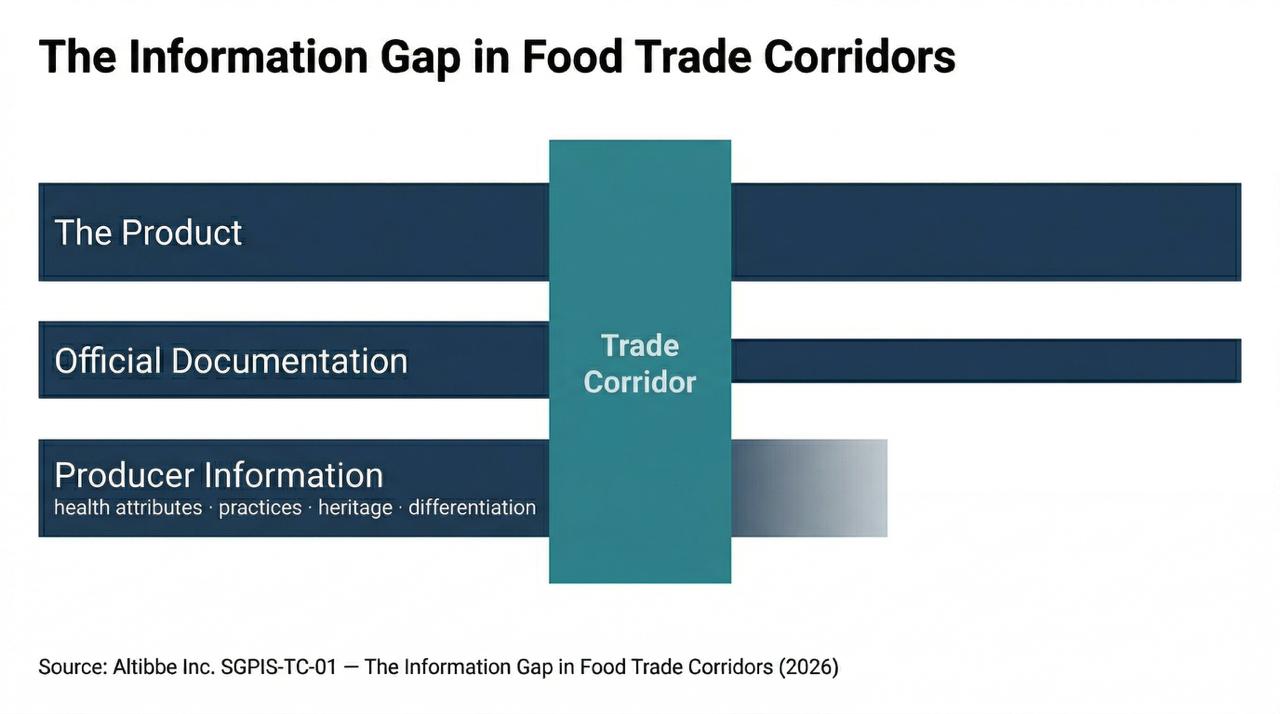
Food trade corridors run on documentation designed for clearance, not communication. The Harmonised System assigns tariff codes for customs administration. Phytosanitary certificates confirm pest and disease status. Sanitary declarations attest to safety. Certificates of origin establish preferential tariff eligibility. Each instrument performs a defined and valuable function within the regulatory architecture of international trade. None was designed to communicate what distinguishes one product from another within the same tariff classification, the same certified category, or the same country of origin.
This paper argues that the information gap in food trade corridors is structural, not incidental. It arises from the fact that trade documentation was designed for admissibility, and the informational layer required for product communication — carrying health attributes, production practices, origin specificity, and producer-level differentiation — was never part of its scope. Digitisation efforts, including electronic certificates and single-window systems, improve the efficiency of clearance. They do not expand what the documentation carries.
Thesis
Documentation moves goods across borders. It does not always carry product meaning.
Position in the series
This paper examines trade documentation. Across the SGPIS series, the same pattern appears from different institutional angles: certification (SGPIS-GQ-01), traceability (SGPIS-GQ-02), nutrition labels (SGPIS-NL-01), geographic indication (SGPIS-PI-01), and India’s product-information stack (SGPIS-SY-01) each perform defined functions, but none consistently carries enough information for the product to remain understood across settings.
Citation
APA
Ahmed, S. (2026). The Information Gap in Food Trade Corridors. Structural Gaps in Product Information Systems, SGPIS-TC-01. Altibbé Research. https://doi.org/10.5281/zenodo.20375811
Institutional
Ahmed, S. (2026). The Information Gap in Food Trade Corridors. Structural Gaps in Product Information Systems, SGPIS-TC-01, v1. Altibbé Research. https://doi.org/10.5281/zenodo.20375811
STRUCTURAL GAPS IN PRODUCT INFORMATION SYSTEMS
SGPIS-TC · Trade & Commerce
When Products Move Faster Than Their Documentation
Trade documentation systems were designed to answer a specific institutional question: can this product cross this border? The instruments that accompany food products through international corridors — harmonised system codes, phytosanitary certificates, sanitary declarations, certificates of origin — answer that question reliably. They do not answer the question that cross-border food trade increasingly asks: what is this product, where does it come from, how was it produced, and what distinguishes it from the product beside it on a procurement shelf? This paper examines why that second question was never within the scope of the first answer — and what the structural consequences of that gap are for trade agencies, institutional buyers, and producers.
Shams Ahmed
Founder & CEO, Altibbe Inc.
March 2026
Published by Altibbe Inc.
EXECUTIVE SUMMARY
Food trade corridors run on documentation designed for clearance, not communication. The Harmonised System assigns tariff codes that classify products for customs administration. Phytosanitary certificates confirm pest and disease status. Sanitary declarations attest to safety standards. Certificates of origin establish preferential tariff eligibility. Each instrument performs a defined and valuable function within the regulatory architecture of international trade. None was designed to communicate what distinguishes one product from another within the same tariff classification, the same certified category, or the same country of origin.
This paper argues that the information gap in food trade corridors is structural, not incidental. It does not arise from poor documentation practice, inadequate digitisation, or insufficient regulatory cooperation. It arises from the fact that trade documentation was designed for admissibility, and the informational layer required for product communication — carrying health attributes, production practices, origin specificity, and producer-level differentiation — was never part of its scope.
Where Papers 1 and 2 in this series examine information loss at the point of interpretation and certification, this paper examines what happens to information in transit. The gap is not only at the label or the certificate. It is structural to how trade documentation moves — or fails to move — with the products it accompanies.
Across multiple trade corridors, the same structural condition is observable: documentation stacks multiply per corridor without translating between them, buyer-side information requirements operate in parallel to official documentation without connecting to it, and the coordination burden falls hardest on the producers least equipped to absorb it. Digitisation efforts — including electronic certificates, single-window systems, and paperless trade initiatives — do not, in their current implementation, expand the informational scope of the documentation they digitise. They improve the efficiency of clearance. They do not expand what the documentation carries.
1. THE PROMISE
The documentation infrastructure supporting international food trade represents one of the most significant institutional achievements in the history of global commerce. The WTO Agreement on Sanitary and Phytosanitary Measures (SPS Agreement, 1995) established a binding multilateral framework for food safety and animal and plant health measures, providing a shared reference standard across 164 member states. The Agreement on Technical Barriers to Trade (TBT Agreement) created equivalent architecture for product standards and labelling. The WTO Trade Facilitation Agreement (TFA, 2017) — the first multilateral trade agreement concluded since the WTO's founding — committed member states to simplifying, harmonising, and digitising customs procedures, with a specific focus on reducing costs for developing-country exporters.¹
The World Customs Organization's Harmonised System, in use since 1988 and now covering approximately 98% of world merchandise trade, provides the classificatory backbone of international trade.² Its six-digit codes enable customs authorities across 200 economies to classify goods consistently, apply appropriate tariffs, and compile comparable trade statistics. For importers and exporters, HS codes are the common language of international commerce — the shared reference that makes global trade legible to regulatory systems that would otherwise have no shared infrastructure.
Phytosanitary and sanitary certificates — issued by national plant protection organisations and competent food safety authorities — perform a function of comparable institutional significance. They provide importing countries with documented assurance that agricultural products meet the pest, disease, and safety requirements of the destination market. Without them, cross-border agricultural trade would require destination-country inspection of every consignment — a logistical impossibility at the volumes modern food trade demands. The certificate is an institutional proxy for trust across regulatory contexts.
Together these instruments have enabled a transformation in global food trade. Global food import expenditure exceeded USD 1.9 trillion annually, reflecting the scale at which these documentation systems now operate.³ Much of that volume — across thousands of product categories, hundreds of trade corridors, and scores of regulatory jurisdictions — moves because the documentation infrastructure works. Harmonised classification, mutual recognition of phytosanitary assurances, and standardised origin certification reduce friction at borders that would otherwise be impassable.
This paper does not question that achievement. The documentation systems described above perform their defined functions reliably. The structural question this paper raises is different: what happens when cross-border food trade asks these instruments to carry information they were never designed to carry?
2. THE STRUCTURAL PROBLEM
In 2023, a cooperative of turmeric producers in Telangana, India, sought to expand into three markets: Japan, the UAE, and Germany. Each required a distinct documentation stack. For Japan: phytosanitary certification from India's National Plant Protection Organisation, Food Sanitation Act residue compliance, and — for organic lines — documentation compatible with JAS organic standards, which carry no equivalency arrangement with India's NPOP programme.⁴ For the UAE: a health certificate, halal certification, and country-of-origin documentation meeting Gulf Standardisation Organisation requirements.⁵ For Germany: phytosanitary certification, EU Maximum Residue Level compliance under Regulation (EC) 396/2005, and third-country organic import compliance under EU Regulation 2018/848.⁶
Three documentation stacks. Three separate administrative processes. Three sets of inspections, attestations, and regulatory submissions — each calibrated to one institutional question: can this product enter this market?
Not one document in any stack was designed to carry what distinguished this cooperative's turmeric from any other: its regional origin within Telangana, its curcumin content by harvest batch, its traditional drying methods, or the community's multigenerational relationship with the crop. That information existed at the farm level. The documentation infrastructure had no mechanism to transmit it.
The same structural condition appears across equivalent export corridors in coffee, cocoa, rice, and spices.
"Trade documentation tells a customs officer what a product is called. It was never designed to tell a buyer what the product is."
This is not a failure of existing systems. It is a mismatch between what they were designed to do and what they are now being asked to carry.
Threshold architecture. The Harmonised System was designed as a classification instrument for customs administration and statistical reporting. HS code 0910.30 covers turmeric — in whole rhizomes, crushed, ground, or processed form — regardless of origin, cultivation method, curcumin concentration, or whether it was grown by a smallholder cooperative using traditional practices or an industrial farm using synthetic inputs.⁷ The code performs its defined function correctly. This is not a limitation of HS design — it is a consequence of using a classification system as a communication system, and the distance between those two functions is the gap this paper diagnoses.
Phytosanitary and sanitary certificates operate on the same architectural logic. They establish that a product meets defined pest, disease, and safety thresholds for entry into the destination market. The threshold is binary — the product either meets it or does not — and the certificate confirms which. Nothing in the phytosanitary certificate's scope requires or enables it to communicate what lies beyond the threshold: what production practices were used, what health attributes the product carries, or what distinguishes one compliant producer from another.
Certificates of origin establish preferential tariff eligibility under bilateral or regional trade agreements. They answer whether the product's origin meets the agreement's rules of origin for duty reduction. They do not describe the production practices at the origin, the producer's relationship with the land, or the characteristics that make one origin's output distinct from another's.
The medium changed. The message did not. Trade facilitation efforts over the past two decades have invested substantially in digitising existing documentation. The UN/CEFACT White Paper on Paperless Trade (2018) provides comprehensive guidance for implementing WTO TFA provisions through electronic documentation — single windows, e-certificates, cross-border data exchange.⁸ The WCO's data management framework updates, its blockchain concept paper, and the digitalisation of certificates of origin all represent genuine operational advances.⁹'¹⁰ They make clearance faster, cheaper, and more reliable.
None of them changes what the documents say. Digitising a phytosanitary certificate produces a phytosanitary certificate in digital form. The information carried is identical. The gap between what trade documentation contains and what product communication requires is not a formatting problem — it is a scoping problem. The medium changed. The message did not.
Buyer-side documentation creates a parallel layer. As official trade documentation handles clearance, importing buyers — retailers, institutional procurement bodies, food service companies — have developed their own information requirements operating in parallel. Supplier questionnaires, responsible sourcing declarations, ESG attestations, residue testing records, and traceability documentation are increasingly standard expectations in EU, UK, and US procurement relationships — documented across supplier audit frameworks in those markets, though no systematic cross-sector survey currently quantifies this layer. The ITC's SME Competitiveness research documents the downstream consequence: as buyer-side requirements proliferate, smaller exporters face disproportionate per-buyer documentation costs because they lack the dedicated documentation functions that larger exporters maintain.¹¹ These requirements are not coordinated with official trade documentation. They occupy a separate administrative layer, reference different standards and frameworks, and require producers to reformat and resubmit information that partially overlaps with official documentation but does not draw from it.
The result is a producer maintaining two simultaneous documentation systems — one for regulatory clearance, one for commercial communication — that do not connect. The information architecture of international food trade has accumulated layers without developing interfaces between them.
Existing instruments — including geographical indication regimes, sustainability standards, and emerging due-diligence frameworks — carry elements of producer-level information within specific categories and corridors. They do not provide a generalisable layer through which that information travels across trade systems.
2A. Why This Is Not a Design Failure
The limitations described above are not the result of poor institutional design. Trade documentation systems were built to answer specific questions, and they answer those questions effectively. The case for the current architecture is coherent.
Border clearance is a public governance function with legal consequences. The phytosanitary certificate is a state-issued document that confers regulatory permissions — it carries legal force in both the exporting and importing jurisdiction. Expanding its scope to carry commercial product information would change the legal character of the document, create liability questions for issuing authorities, and potentially compromise the credibility of the assurance it provides. The scope limitation is a deliberate architectural choice that preserves the document's institutional integrity.
The Harmonised System's value derives from its universality. A classification instrument that 200 economies use consistently requires definitional stability and bounded scope. A system that attempted to encode product differentiation — heritage practices, seasonal variation, cultivation method — would face irresolvable definitional disputes and would lose the consistency that makes it useful. The HS is precise precisely because it does not try to describe everything.
Trade facilitation agreements, including the WTO TFA, prioritise reducing costs for the most commercially disadvantaged participants in global trade: developing-country exporters and small and medium enterprises. Adding documentation requirements — even for product communication purposes — would add burden to the actors whose primary obstacle is already documentary complexity. The architecture deliberately avoids loading additional obligations onto the existing documentation stack.
The structural problem this paper diagnoses emerges not from any single system's failure, but from what happens when official trade documentation — correctly scoped for clearance — operates as the primary information infrastructure for food trade corridors that increasingly require product communication. That is not what it was built for. The gap is structural, and it is not addressable at the layer of clearance documentation.
3. EVIDENCE AND EXAMPLES
The following evidence is organised around three structural dynamics that map directly to the paper's implications: documentation stacks multiplying without translating, buyer-side requirements operating outside the official layer, and the burden falling disproportionately on smaller producers.
Documentation stacks multiply without translating
The India–Japan organic corridor illustrates the translation problem precisely. India's NPOP organic programme, administered by APEDA under the Ministry of Commerce, is one of the largest organic certification programmes in the world by area and producer count. Japan's JAS organic standard, administered by MAFF, is the gateway to Japan's premium organic market segment. The two systems share a common aspiration — certifying organic production practice — but lack a bilateral equivalency arrangement. A producer certified under NPOP seeking to export organic produce to Japan must either obtain separate JAS-compatible certification through a MAFF-accredited body or export on a non-organic basis, forfeiting the premium positioning their practices have earned.¹²
This is not a documentation burden problem in the conventional sense — the producer's practices meet the substantive standard. It is an architectural translation problem: two systems built for the same purpose, with no interface between them. The information that the producer's certification represents cannot be read across systems. It must be re-documented.
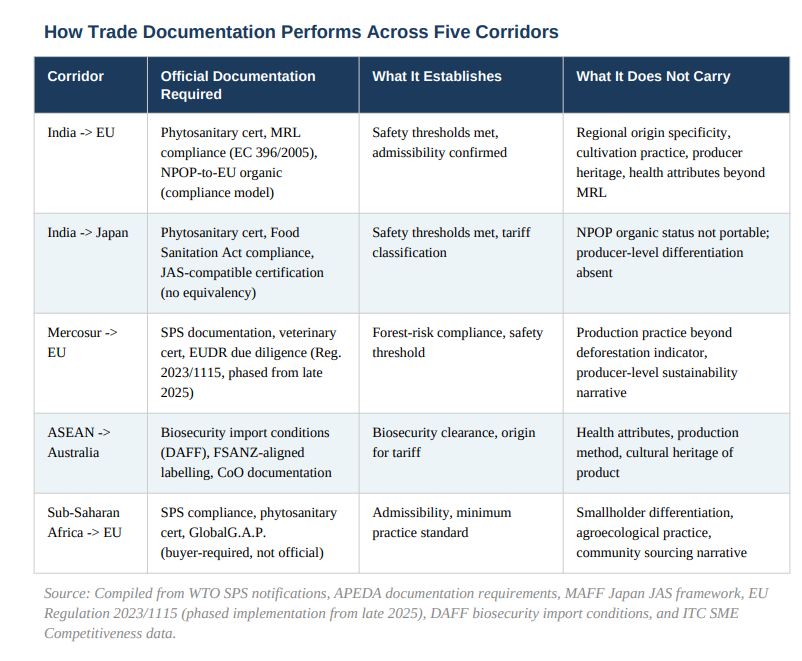
The table below maps five major food trade corridors against the documentation events required for clearance and what each event carries — and does not carry — in terms of product-level information.
TABLE: How Trade Documentation Performs Across Five Corridors
Table footnote: Source: Compiled from WTO SPS notifications, APEDA documentation requirements, MAFF Japan JAS framework, EU Regulation 2023/1115 (phased implementation from late 2025), DAFF biosecurity import conditions, and ITC SME Competitiveness data.
The translation problem is not a compliance problem — both systems require the same underlying practices. It is an architectural problem: information that exists at the production level cannot travel between systems. This creates a value communication constraint for trade agencies whose mandate extends to export value capture alongside market access.
Buyer-side requirements operate outside the official layer
The emergence of private buyer documentation requirements — responsible sourcing questionnaires, ESG supplier attestations, human rights due diligence declarations, and traceability records — represents the commercial system's attempt to fill the information gap that official documentation does not address. In EU markets, UK supply chains, and US institutional procurement, these requirements have become standard practice across retail, food service, and public procurement relationships.¹³
These requirements are not coordinated with official trade documentation. A producer completing SPS compliance documentation for customs clearance and simultaneously completing a retailer's supplier questionnaire is working with two separate information architectures that partially overlap but draw on different standards, reference different frameworks, and produce outputs that do not reference each other. The producer re-enters substantially the same information in different formats for each buyer relationship, in addition to official documentation.
The buyer-side questionnaire layer is the commercial system's workaround for an architectural absence. Its limitation is that it is per-buyer, non-standardised, and non-cumulative. This creates a product comparison problem for institutional procurement bodies that need to evaluate equivalent products sourced from multiple corridors.
The burden falls disproportionately on smaller producers
UNCTAD data indicates that non-tariff measures — including the documentation requirements associated with SPS compliance, technical standards, and origin certification — can add approximately 20% to food trade costs, with the burden falling disproportionately on developing-country exporters.¹⁵ The documentation asymmetry this paper identifies is one structural contributor to that pattern.
For smallholder cooperatives and SME exporters, the challenge is not that individual documents are unreasonable — each phytosanitary certificate, each compliance declaration is defensible on its own terms. The challenge is the cumulative architecture: multiple non-translating systems, each requiring a separate documentation event, each resetting rather than building on the producer information already documented elsewhere.
The FiBL analysis of the EU's transition from equivalency to compliance for third-country organic imports — effective from January 2025 — found that more than two-thirds of current small organic producer groups supplying the EU market would need to adapt their legal, organisational, or certification setup to continue supplying that market.¹⁶ The disruption is not a product of any single regulation being unreasonable. It is a product of an architecture that requires producers to re-document across systems rather than having their documentation travel with them.
The architecture requires producers to re-document at each corridor entry point rather than building on information already established. This creates a compounding access asymmetry: multi-market reach becomes structurally contingent on documentation capacity, not production quality.
4. IMPLICATIONS
The structural dynamics described in the preceding sections carry distinct operational consequences for three sets of institutional actors.
For trade agencies and export promotion bodies, the gap is a value communication problem, not a compliance problem. For agencies whose mandate extends to export value capture alongside market access, the absence of a product communication layer above clearance documentation represents a structural obstacle. An export promotion body can support producers in meeting SPS requirements, navigating HS classification, and obtaining phytosanitary certification. It cannot currently support producers in communicating — through any structured, portable documentation system — the attributes that distinguish their products within the same certified category and tariff classification. The documentation gap compresses value by making undifferentiated what is not undifferentiated at the production level. This constraint does not arise from inefficiencies in trade facilitation; it arises from the informational scope of the documentation itself.
For institutional procurement bodies, the gap is a comparison problem. A hospital procurement system, government school meal programme, or corporate food service operation sourcing products from multiple origin countries faces a structural inability to compare equivalent products across documentation systems. Two organic turmeric products — one from India, one from Sri Lanka — may be substantively comparable in production practice but documented through non-equivalent systems whose outputs are not legible to each other. Procurement officers make sourcing decisions in the absence of comparable producer-level information — not because the information does not exist, but because no structured mechanism brings it through the corridor.
For policymakers and regulators, the gap signals the boundary between trade facilitation and trade communication. Two decades of trade facilitation investment — the WTO TFA, single-window systems, e-certification, paperless trade initiatives — have substantially reduced the friction of clearance. They have not addressed what crosses borders with food products and what that information enables or prevents. The EU Digital Product Passport represents the closest existing institutional parallel: a regulatory framework requiring structured product data to be available beyond what the product label carries.¹⁷ Its initial scope covers batteries, textiles, and electronics. Food systems are not the lead use case. No equivalent regulatory initiative currently requires food trade documentation to carry the full range of producer-level information — health attributes, heritage practices, origin specificity, seasonal variation — that commercial and institutional markets are asking for through other channels.
5. TOWARD STRUCTURAL ALTERNATIVES
The evidence reviewed in the preceding sections confirms that trade documentation performs its defined function reliably. The structural gap diagnosed here does not arise from that function's inadequacy — it arises from the gap between what the documentation was designed to do and what cross-border food trade increasingly requires it to carry.
Any information architecture capable of operating at the layer above clearance documentation would need to satisfy several structural requirements.
It would need to make product information a persistent asset that travels with the product rather than a compliance event that resets at each border crossing. The current architecture requires producers to re-document at each corridor entry point. An alternative would need to build on documented producer information rather than requiring it to be re-established from scratch for each destination system.
It would need to operate independently of the clearance layer — not replacing or modifying the regulatory documentation infrastructure, but providing a complementary layer that the clearance infrastructure does not currently carry. The phytosanitary certificate should continue to do what the phytosanitary certificate does. The product communication layer needs to operate above it, not instead of it.
It would need to be legible across jurisdictions without creating new equivalency dependencies. The organic certification translation problem illustrates what this requirement addresses: two systems built independently, each requiring separate documentation for the same underlying practices. A communication layer would need to carry producer information in a form that is structurally comparable across destination markets without requiring bilateral negotiation to establish.
It would need to be accessible to producers of varying scale — including those for whom multi-system documentation maintenance is already a disproportionate burden. An architecture that can only be maintained by exporters with dedicated documentation functions replicates the asymmetry already present in the existing system.
Several developments in the institutional environment suggest that movement toward such an architecture is beginning, if unevenly. The Codex Alimentarius Commission's CXG 104-2024, adopted in November 2024, establishes principles for food information provision in e-commerce contexts that extend beyond what physical or static documentation can carry.¹⁸ GS1's Digital Link standard and its Sunrise 2027 deadline creates technical infrastructure through which structured product data could be accessed dynamically rather than compressed into a static certificate.¹⁹ The EU Digital Product Passport establishes a regulatory model in which structured data availability is a requirement, not an option.
None of these developments resolves the structural gap identified in this paper. But they confirm that the information architecture of trade documentation is beginning to evolve beyond the constraints of the clearance paradigm that originally defined it.
This paper does not propose a specific model. It outlines structural requirements that any viable alternative would need to satisfy.
REFERENCES
World Trade Organization. Agreement on Sanitary and Phytosanitary Measures. Geneva: WTO, 1995. Also: WTO. Trade Facilitation Agreement. Geneva: WTO, 2017. Entry into force 22 February 2017.
World Customs Organization. Harmonised Commodity Description and Coding System (HS Convention). Brussels: WCO, 1988 (amended 2022). Coverage data: WCO, The HS in Figures, 2023.
Food and Agriculture Organization of the United Nations. Food Outlook — Biannual Report on Global Food Markets. Rome: FAO, November 2024.
Ministry of Agriculture, Forestry and Fisheries, Japan. Japan Agricultural Standard for Organic Plants (JAS 0059:2022). Tokyo: MAFF, 2022. Also: APEDA. National Programme for Organic Production (NPOP): Standards for Organic Production. Ministry of Commerce and Industry, Government of India.
Gulf Standardisation Organisation. GCC Guide for Control on Imported Foods. Riyadh: GSO/FAO, 2015.
European Parliament and Council. Regulation (EU) 2018/848 on organic production and labelling of organic products. Official Journal of the European Union, L 150/1. Also: European Parliament and Council. Regulation (EC) No 396/2005 on Maximum Residue Levels of pesticides. Official Journal, L 70/1.
World Customs Organization. HS Nomenclature 2022 Edition. Chapter 9: Coffee, tea, maté and spices. Heading 0910: Ginger, saffron, turmeric, thyme, bay leaves, curry and other spices.
UN/CEFACT. White Paper on Paperless Trade: Guidance for Countries to Implement WTO TFA Paperless Trade Provisions. UN/CEFACT, 2018.
World Customs Organization. WCO Data Management Framework: Updates and Revisions. Brussels: WCO, 2022.
World Customs Organization. WCO Concept Paper on Blockchain for Customs. Brussels: WCO, 2025.
International Trade Centre. SME Competitiveness Outlook 2023: Competing for Sustainability. Geneva: ITC, 2023.
Meinshausen, F., Richter, T., & Huber, B. Impact of the New EU Organic Regulation on Smallholder Value Chains and the European Organic Sector. Frick: Research Institute of Organic Agriculture (FiBL), 2024.
OECD. Digital Opportunities for Sanitary and Phytosanitary Systems and the Trade Facilitation Effects of SPS Electronic Certification. Paris: OECD, 2021.
International Trade Centre. SME Competitiveness Outlook 2023. (See Reference 11.)
United Nations Conference on Trade and Development. Key Statistics and Trends in Trade Policy 2024. Geneva: UNCTAD, 2024.
Meinshausen, Richter & Huber. (See Reference 12.)
European Commission. Ecodesign for Sustainable Products Regulation (ESPR). Regulation (EU) 2024/1781. Official Journal, June 2024.
Codex Alimentarius Commission. Guidelines on the Provision of Food Information for Pre-Packaged Foods to be Offered via E-Commerce (CXG 104-2024). Adopted at the 47th Session, November 2024.
GS1. GS1 Digital Link Standard. 2024. Industry adoption deadline ("Sunrise 2027") for 2D barcode compliance.
SGPIS-TC-01 | Structural Gaps in Product Information Systems — Trade & CommercePublished by Altibbe Inc. | March 2026Version 1.0 | March 2026This paper is part of the Structural Gaps in Product Information Systems series. Further research is available at altibbe.com/research